

You may want to feel stronger carrying a suitcase, more comfortable in your clothes, or more confident trying something physical. Perhaps you are returning to an activity you used to enjoy, or learning to use weights for the first time. You do not need to have been athletic at twenty-five to begin now. Start with what you want to feel more capable doing, then learn a manageable way to practice.
Strength training for women over fifty can be shaped around those personal goals. Carrying luggage, getting up from a low chair, and feeling at ease in the weight room are all worthwhile things to discuss with a coach. Your starting point should reflect your experience, health, and daily life, with room to say what feels unfamiliar and what you would like help learning.
This guide is educational, not an individualized program or medical clearance. The example sessions are starting frameworks for discussion with a qualified coach. Existing conditions, recent surgery, significant symptoms, or clinician-imposed restrictions can change what is appropriate. Tell your coach about those factors and involve your healthcare professional when needed.
1. Define strength in terms of your own life
Before choosing exercises, write down three situations in which you would like to feel more capable. Think about the actual day: carrying groceries from the car, lifting a suitcase, using stairs, moving a planter, playing with grandchildren, or simply having more confidence when you try something physical. Specific situations give your training a purpose you can recognize outside the gym.
Then separate your desired outcome from a deadline. “I want to feel comfortable learning to lift” is a useful goal. “I must completely transform in six weeks” creates pressure without explaining what successful training would look like. You can have ambitious long-term goals while choosing modest, clear actions for the first month.
For example, an early process goal could be attending two planned sessions most weeks. Another could be learning how to adjust the seat on the machines you use. A third could be writing down the exercises and how they felt. These are not dramatic achievements in a social-media sense, but they make the routine easier to understand and repeat.
Stanford Lifestyle Medicine’s guide emphasizes strength as part of daily function for women over fifty and describes common movement categories such as pushing, pulling, squatting, hinging, and single-leg work. Those categories can help organize a program without tying you to a particular piece of equipment. Read Stanford’s overview.
Your own preferences still belong in the plan. You may enjoy a sociable environment or prefer a quiet session. You may want detailed explanations or a few clear cues. You may like machines because setup feels stable, or appreciate learning simple free-weight exercises. A good coach can explain the choices and help you practice rather than insisting there is only one legitimate way to train.
Avoid treating age as a complete description of ability. Two women of the same age can have very different exercise histories, comfort levels, health considerations, and daily demands. A program should respond to the person, not a stereotype about what women over fifty can or cannot do.
Try this short preparation exercise. Finish the sentences “I want to be able to…,” “I currently find it difficult to…,” and “I can realistically make time for….” Bring the answers to your first conversation. They give the coach more useful information than a vague wish to become fitter.
You can revisit those sentences later. Some goals may become less important, and new ones may emerge as you learn what training feels like. That is part of making the program personal. Your first goal is a starting point, not a contract that prevents you from changing your mind.
2. Make the first few visits about learning
An unfamiliar gym can feel like a place where everyone else already knows what to do. In reality, equipment, exercise names, and training conventions have to be learned. You are allowed to ask basic questions, repeat instructions, and take time to understand the setup.
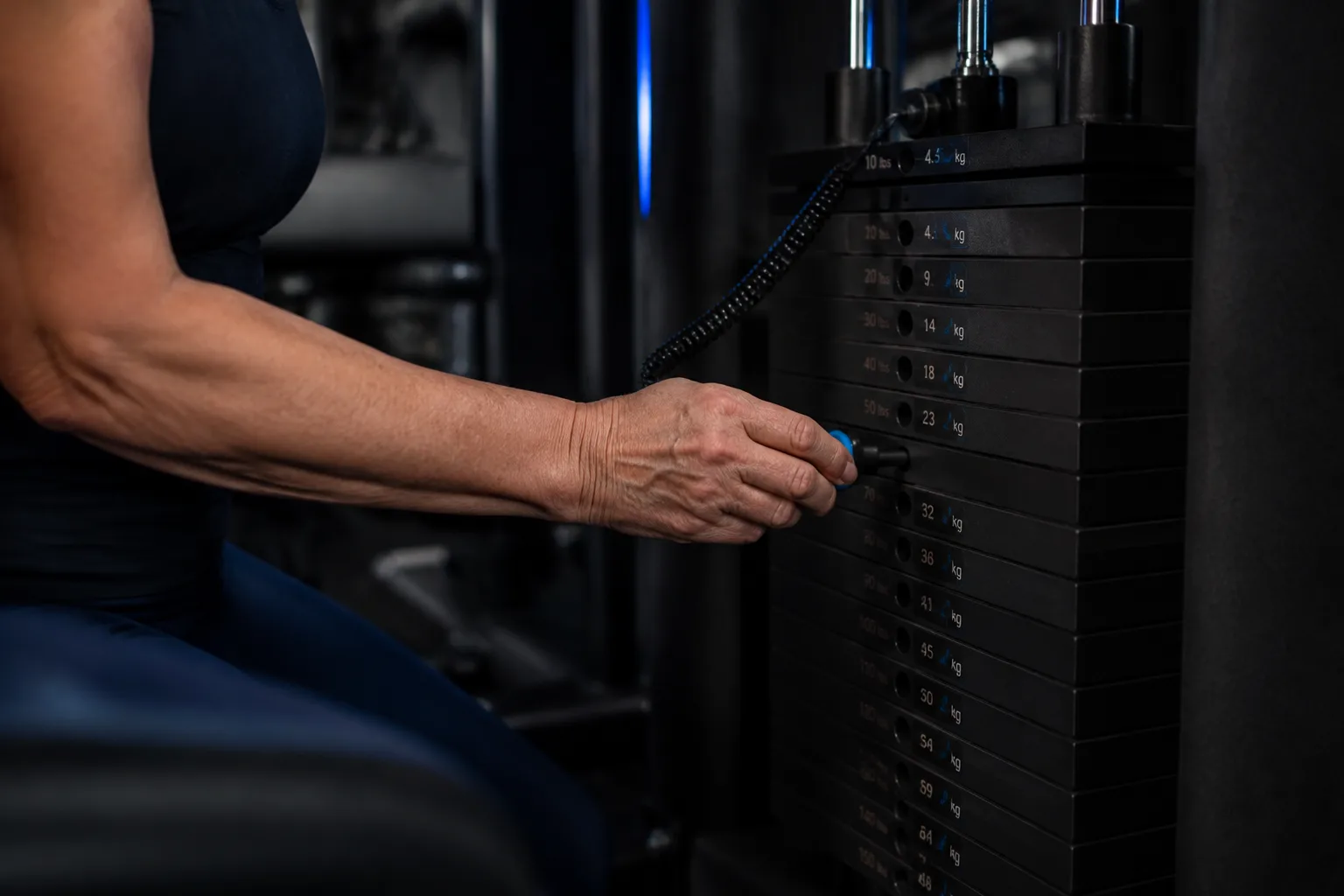
For the first visit, focus on orientation. Learn where to put your belongings, how to ask for help, and which equipment you will use. Ask the coach to show you how adjustments work and where your body should be positioned. If a machine has several settings, write down the ones that fit you instead of relying on memory.
During an exercise, one clear cue is often easier to use than a long list. Ask the coach what to focus on first. You might practice the setup, then the movement, then the pace. The goal is not to perform every detail perfectly on the first attempt. It is to build an understandable sequence you can repeat.
Start with manageable resistance while you learn. Healthdirect advises beginners to learn equipment use, control the movement, and build the load gradually. It also emphasizes appropriate technique and avoiding exercises that cause pain. See its beginner guidance.
You can ask what the exercise is intended to train and what a suitable alternative would be if the setup does not work for you. This is especially useful if you have difficulty getting onto the floor, dislike a certain machine, or feel unsteady in a position. A modification should preserve a useful purpose without forcing a version you cannot comfortably practice.
Pay attention to your understanding after the session. Could you name the main movements you practiced? Do you know what you would repeat next time? Do you understand any instruction about activity between visits? If not, ask for a brief written summary or a simpler explanation. Confusion is information the coach can use to improve the instruction.
Do not judge the first session by how sore you become. A session can be worthwhile because you learned a skill, found a suitable exercise, or established a repeatable starting point. Chasing exhaustion can distract from those early goals, particularly when you are still learning how different exercises feel.
A useful first-visit checklist is practical rather than athletic. Wear clothing you can move in, bring water, arrive with enough time to settle in, and share relevant limitations before starting. If you have instructions from a clinician, bring the details rather than trying to summarize them from memory under time pressure.
Afterward, note one thing you learned and one question for next time. That short reflection makes progress visible even before a number on a weight stack changes. Learning the routine is part of the work, and it deserves attention.
3. Choose exercises by their purpose
A program becomes easier to understand when exercises are grouped by what they ask you to do. You do not need to memorize anatomy to use this idea. Think in ordinary actions: stand up, push, pull, bend at the hips, carry, or step onto something stable.
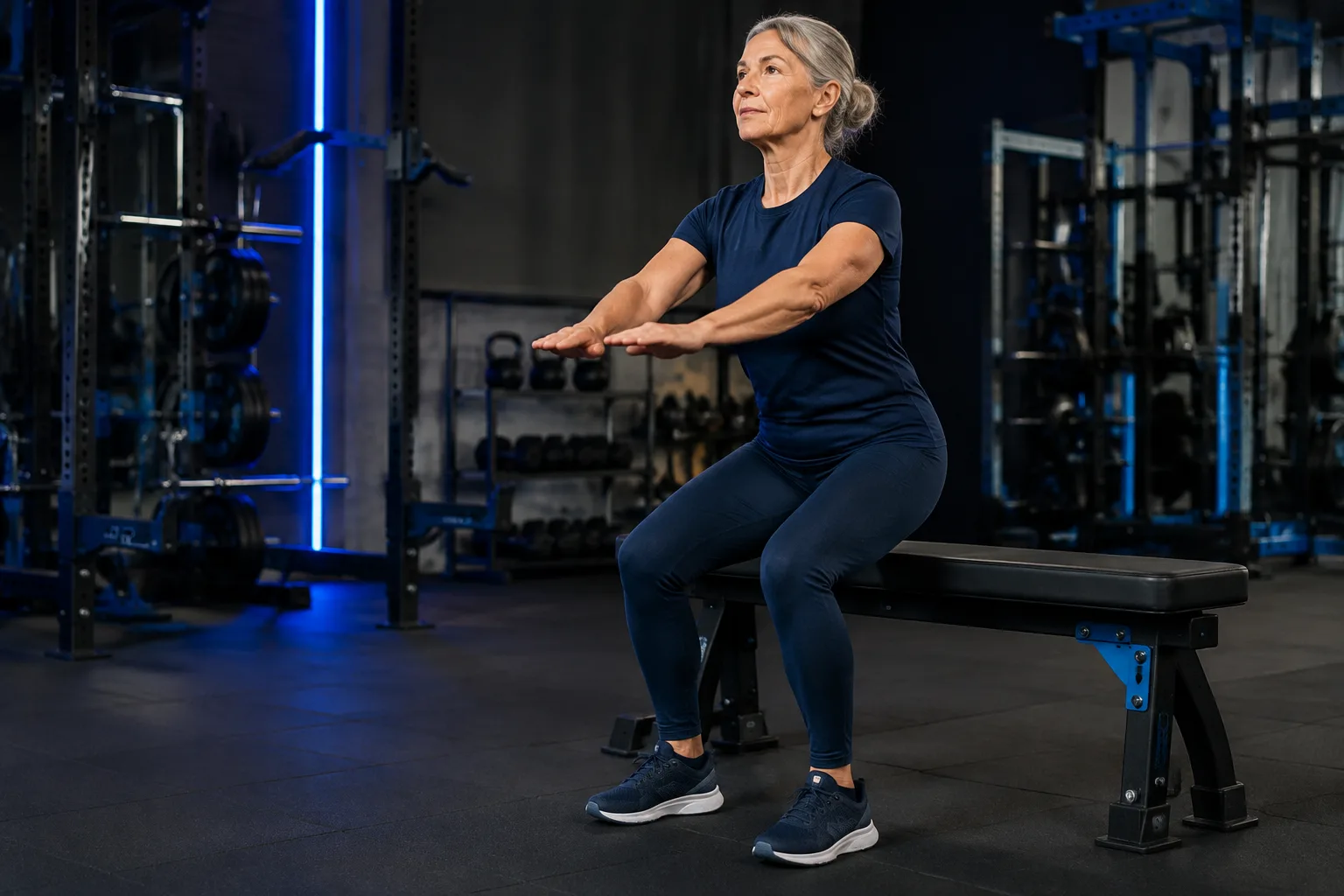
For standing up, a coach might begin with a chair sit-to-stand or another squat variation. The height of the chair, available support, and range of motion can change the difficulty. The useful version is the one you can practice with control and appropriate guidance, not the deepest or most visually impressive version.
For pushing, a wall push-up, raised-surface push-up, or suitable chest-press machine might be considered. These are different setups for a related action. Your coach should help choose a version based on your ability to position yourself comfortably and control the movement. There is no requirement to earn the right to use a machine by first mastering floor push-ups.
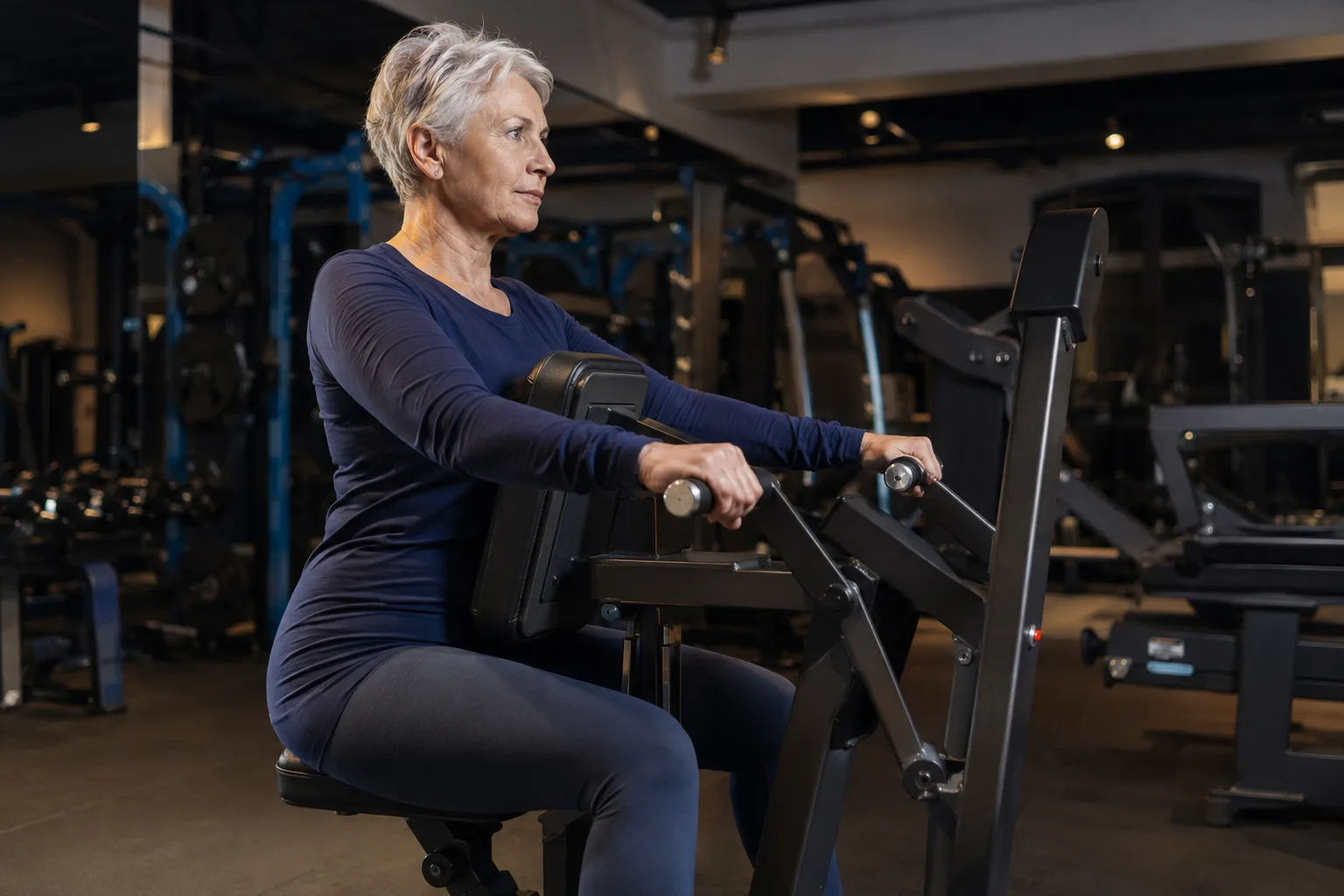
For pulling, a seated row or a properly anchored resistance-band row may be options. Ask how to set up the equipment and how to keep the movement deliberate. With bands, secure anchoring and equipment condition matter. If you are not confident about the setup, have a qualified person demonstrate it rather than improvising an attachment point.
For a hip-hinge pattern, the first step may be learning how to move the hips while maintaining a comfortable trunk position. A coach might use an unloaded practice drill before introducing a weight. The exercise should not become a test of how low you can reach. A controlled range that suits you is more useful than forcing a position to match a photograph.
Stepping and carrying can connect training to everyday tasks, but the setup needs to match your balance and confidence. A low stable step with support is different from a tall box. Carrying light objects over a clear short path is different from a heavy challenge in a crowded gym. Ask the coach to explain why a particular version belongs in your plan.
Here is a discussion framework rather than a prescription:
Swipe to explore the table ↔
| Movement purpose | Possible starting option | Question for your coach |
|---|---|---|
| Stand up | Chair sit-to-stand | What height and support suit me? |
| Push | Wall or raised-surface push-up | Which angle lets me control the movement? |
| Pull | Supported row | How should I adjust the equipment? |
| Hinge | Unloaded hip-hinge practice | What range can I manage comfortably? |
| Step or carry | Supported low step or light carry | What setup fits my balance today? |
You do not need every variation in every session. A coach can choose a small selection, explain the purpose, and repeat enough of the plan for you to become familiar with it. Variety can be enjoyable, but constant novelty is not required to make the routine worthwhile.
4. Build a weekly schedule you can repeat
A strong plan on paper is only useful if it has a place in your week. Start with the appointment windows you can realistically protect. Consider travel, work, caregiving, social commitments, and the time you need to prepare or change afterward. The whole visit needs to fit, not just the minutes spent exercising.
The CDC recommends muscle-strengthening activity on at least two days each week for adults, together with aerobic activity. That broad recommendation does not determine your exact exercises, loads, or coaching schedule. Read the adult guidelines.
For a discussion example, you might consider two strength sessions on separated days, with comfortable walking or other suitable activity on some of the days between. The separation gives you space to notice how you respond and to return to the next session with a clear plan. Your own schedule may use different days, and a qualified professional can help adapt it.
A hypothetical week could look like this: Monday is a coached strength session, Tuesday is an ordinary walk, Wednesday is a flexible day, Thursday is another strength session, and the weekend includes an enjoyable activity that fits your circumstances. This is an organizational example, not a guarantee that this pattern is appropriate for every reader.
Choose a default appointment and a backup option. If Thursday morning is often interrupted, identify another realistic window before the conflict happens. A backup reduces the need to make a new decision when you are already busy. Ask the studio how rescheduling works so the backup fits its actual policies.
If you are seasonal in Boca Raton or travel frequently, discuss continuity early. You might need a simple plan for time away or a way to resume when you return. Ask whether that support is included. Do not assume that a package automatically covers remote coaching or programming outside the studio.
It can help to attach preparation to an existing routine. Set out training clothes after dinner, keep a bag near the door, or place appointments beside other fixed commitments in your calendar. These choices are small, but they remove repeated decisions that can make attendance harder than it needs to be.
Avoid making the schedule so rigid that one missed session feels like the whole week has failed. A missed appointment is a situation to respond to. It does not erase the sessions you completed or require a punishing makeup workout. Discuss how to return to the ordinary plan rather than trying to repay an imagined exercise debt.
Review the schedule after several weeks. Look for recurring conflicts rather than blaming motivation for everything. If a time consistently fails, change the time. If the commute is too demanding, reconsider the location or format. The best routine is one that respects your life enough to remain part of it.

5. Use a simple starting-session framework
A first program should be easy enough to explain that you know what happens when you arrive. A coach might organize the session into preparation, a few strength movements, and a short review. The exact exercises and amount of work should depend on your starting point.
Preparation can include a brief conversation about how you feel and easy movement that relates to the exercises planned. If a particular area needs more careful preparation, the coach may take more time. A timer should not force you to rush through unfamiliar setup or ignore a concern you need to discuss.
The main work can use a small number of movements from the categories above. For example, a coach might select a supported lower-body exercise, a push, and a pull for an introductory session. That limited selection allows time to teach and observe rather than filling the appointment with an exhausting tour of equipment.
Ask how many repetitions to try and what should make you stop a set. You should understand the instruction before starting. During early practice, the answer may emphasize maintaining control and stopping before the movement becomes uncertain. A coach can then adjust the difficulty based on what they observe and what you report.
Rest is part of the session. You do not need to keep moving simply to demonstrate effort. If you need more time to recover your breathing or understand the next instruction, say so. The plan should allow useful practice rather than making each transition feel like a race.
A sample learning session might be organized like this:
- A brief check-in and equipment orientation.
- Easy practice of the main movement patterns.
- A small amount of suitable strength work with coaching and rest.
- A repeat of one movement that would benefit from another calm attempt.
- A short review of what you learned and what happens next.
Use this outline to discuss what a first visit could look like. It does not prescribe a fixed load or amount of work. Your coach should choose the exercises, resistance, and workload for your starting point, so two people can follow this sequence and still have quite different sessions.
If you prefer a shorter appointment, ask the coach to narrow the session’s purpose. Perhaps the first visit focuses on learning two movements well, with another movement introduced later. A longer appointment may provide more time for questions or rest. Our thirty-minute training guide explains how to think about focused sessions without cramming in more exercises.
End the session by making the next visit predictable. Know when it is scheduled, whether you will repeat the same movements, and whether there is anything suitable to practice independently. If you are unsure about an exercise outside the coached setting, ask before trying to recreate it from memory.
A calm, understandable beginning can make returning feel easier. You are building a skill and a routine at the same time. Neither requires the first session to prove everything you might eventually be capable of doing.

6. Progress without making every session a test
Progression means changing the challenge over time in response to what you can do. It does not mean adding weight automatically at every visit. Sometimes the useful next step is repeating the same exercise with more confidence, improving the setup, or completing the planned work with clearer control.
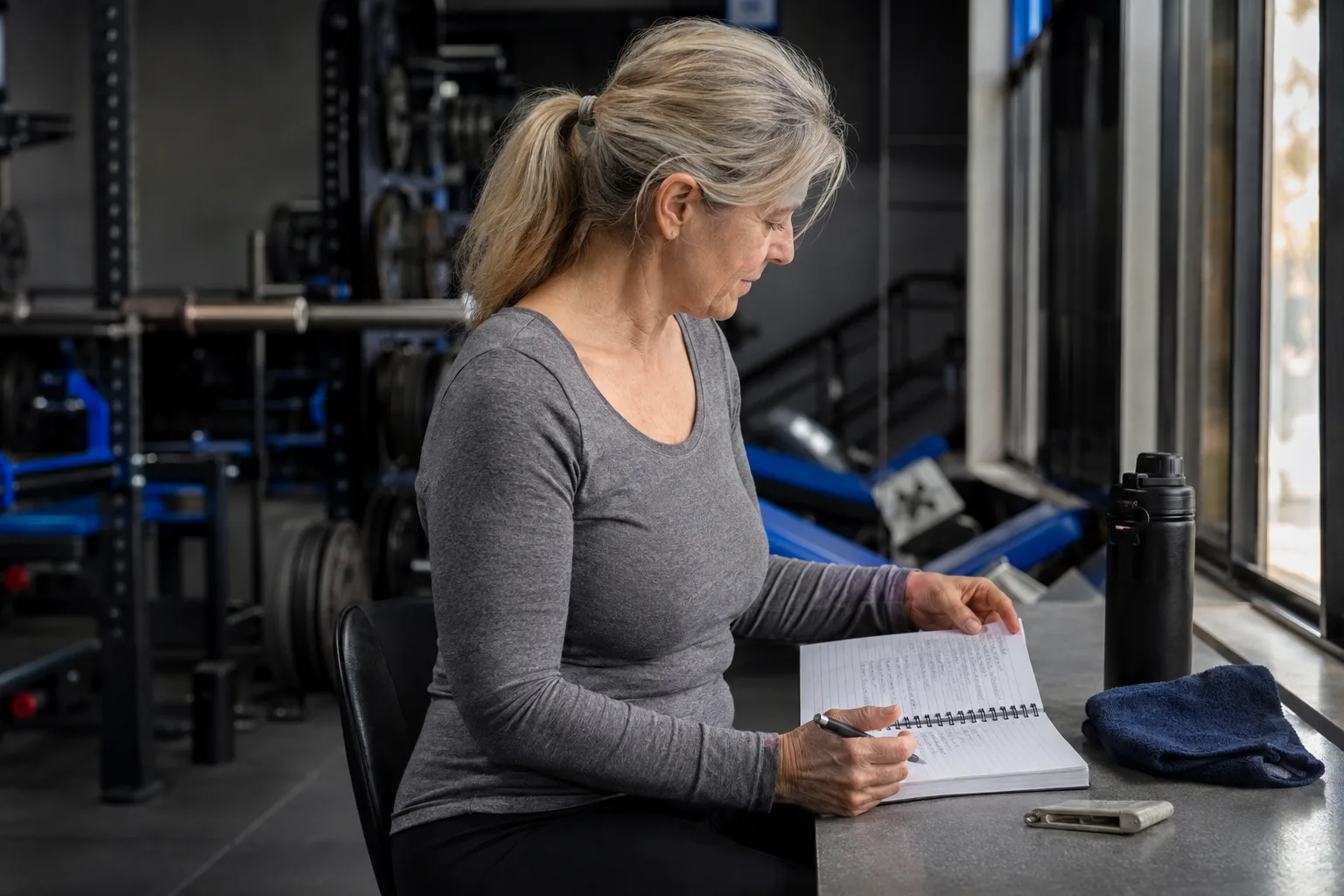
Start by recording enough information to compare sessions. Write the exercise, the resistance used, the repetitions completed, and a brief note about how it felt. If the exercise uses a machine, include the settings. If a variation matters, describe it. “Chair squat from the higher bench” is more informative than simply writing “legs.”
Your coach can use those notes together with observation. If the movement is controlled and the work has become comfortably manageable, a small change may be appropriate. That could involve resistance, repetitions, range, or another aspect of the exercise. Changing one important variable at a time makes it easier to understand the effect.
The American College of Sports Medicine’s 2026 guidance emphasizes regular resistance training and individualization rather than unnecessary complexity. It also notes that equipment type and highly elaborate techniques are not the central requirement for the average healthy adult. Read the ACSM update.
Avoid turning a single difficult day into a verdict on your progress. Sleep, stress, unfamiliar equipment, and the ordinary variation in how you feel can affect a session. Tell the coach what is different. A suitable adjustment on that day can preserve useful practice without pretending every appointment should produce a new record.
You can ask for a simple progression rule in ordinary language. For example: “When I can complete the planned work with control on more than one occasion, what would we change next?” The exact answer should come from your coach and your program. What matters is that you understand the decision rather than feeling that difficulty changes randomly.
There is also progress in independence. You might need fewer reminders to set up a machine, understand which weight to start with, or recognize when to ask for a modification. These changes can make the gym feel less intimidating and allow more attention to the exercise itself.
If you enjoy numerical goals, keep them specific and comparable. Compare the same exercise with the same setup, rather than assuming a heavier number on a different machine means the same thing. Machines can differ in their mechanics. A training log is most useful when its entries describe similar conditions.
If numbers make training feel stressful, ask the coach to emphasize another review format. You can still use a structured program while focusing on attendance, confidence, technique, or everyday activities. The method of feedback should help you engage with training, not make every visit feel like an exam you might fail.
7. Give recovery and everyday habits a practical place
Recovery is easier to plan when it is treated as part of ordinary life rather than another demanding project. Begin with the basics you can observe: how you sleep, whether you arrive rushed or depleted, how the schedule feels, and whether the planned workload fits the rest of your week.
Keep the conversation specific. “I slept poorly for three nights” gives your coach useful context. “My legs are still unusually uncomfortable from the previous session” is more informative than saying you feel weak. The coach can use that information to discuss an adjustment or whether another professional should be involved.
The National Institute on Aging describes strength activity as one part of a broader active routine and advises allowing recovery between sessions that work the same muscle groups. Its guidance also connects strength with everyday function. Read the NIA exercise overview.
Do not assume that recovery requires purchasing equipment, supplements, or elaborate treatments. You can first examine whether the training plan is sensible, whether meals are regular, whether you have enough opportunity for sleep, and whether you are trying to add too many demanding activities at once. Discuss persistent concerns with an appropriate professional rather than searching for a product to compensate for an unsuitable schedule.
Food can be approached practically. Think about whether your usual meals include a variety of foods and whether your training time makes eating inconvenient. If you routinely skip lunch and arrive at an evening session feeling unprepared, the first conversation may be about a realistic meal schedule. Individual nutrition targets belong with a suitably qualified professional who understands your needs.
A simple meal does not have to look like a fitness advertisement. You might choose familiar foods that fit your preferences and circumstances. Planning a few reliable options can be more useful than attempting a complete dietary overhaul in the same week you begin training. Your routine has a better chance of becoming understandable when changes are introduced thoughtfully.
If menopausal symptoms, sleep disruption, or other health issues are affecting your daily life, discuss them with your healthcare professional. A trainer can adapt the exercise conversation to information you share, but should not diagnose the cause or promise to treat symptoms through a program. Keep the roles clear so you receive appropriate support.
Build a short recovery note into your log if it helps: sleep was typical or disrupted, energy felt usual or different, and any symptom worth mentioning. You do not need to collect endless data. A few observations can help you and your coach notice patterns without making training feel like constant self-surveillance.
Use these observations to talk about what would make the next session manageable. You may need to discuss a different appointment time or how the planned work fits a demanding week. Keep the conversation practical, and bring persistent concerns to the appropriate professional instead of trying to solve every difficulty on your own.

8. Work with concerns instead of ignoring them
A good training environment makes it easy to say that something does not feel right. You should not have to choose between appearing committed and describing discomfort. Clear communication helps the coach understand whether to change the exercise, stop the session, or recommend appropriate professional input.
Before starting, share relevant diagnoses, recent procedures, current symptoms, and any instructions you have received from a clinician. You do not need to disclose private information to everyone in a gym. Discuss an appropriate channel with the person responsible for your program. Accurate information is more useful than a vague warning that an area is “bad.”
If you have osteoporosis, a history of fractures, significant balance difficulty, or another condition affecting exercise choices, ask your healthcare professional what restrictions or considerations apply. This article does not provide a condition-specific exercise prescription. A generic photograph or example routine should not override advice tailored to you.
During training, describe the sensation and its location rather than trying to diagnose it yourself. Is it sharp, sudden, unfamiliar, or associated with a particular movement? Does it stop when the movement stops? The coach should take the report seriously and stay within their scope. Do not continue a painful exercise simply because a set is unfinished.
Stop exercise and seek urgent help for concerning symptoms such as chest pain, fainting, or severe unusual shortness of breath. For persistent or worsening nonurgent pain, arrange appropriate clinical assessment. These are reasons to seek the right support, not problems to solve by selecting a harder workout.
Some concerns are about confidence rather than a symptom. You may be nervous about getting down to the floor, worried about losing balance, or uncomfortable using equipment you cannot quickly exit. Tell the coach. A more supported setup or a different exercise can make the practice more approachable while the plan develops.
Ask what the alternative is before deciding you cannot train a movement category at all. A floor exercise may have a standing or seated option. An unsupported movement may have a supported version. The coach should explain the purpose and help choose an appropriate alternative rather than making you copy another person’s setup.
At the same time, accept that some questions require another professional. A trainer who refers you for assessment when something is outside their role is respecting the limits of the service. That can be a useful sign of judgment, not a lack of enthusiasm for helping you.
The best ongoing habit is honest reporting. Mention changes early, ask questions when instructions are unclear, and keep relevant clinical advice available. You can be motivated and cautious at the same time. Suitable training is built through those conversations, not by pretending concerns do not exist.

9. Measure progress without reducing yourself to a number
A useful review starts by returning to your original goals. If you wanted to feel more confident in the gym, ask whether you now understand the routine better. If you wanted to establish consistency, look at attendance and the obstacles you have solved. If you wanted to improve a specific activity, discuss an appropriate way to assess that activity.
Body weight is not a complete measure of training progress. Neither is a single scan result or photograph. These may be relevant to some goals, but they should be interpreted in context and should not replace the conversation about strength, function, confidence, and the routine itself.
Create a small set of measures that reflect your priorities. You could track planned sessions attended, a few comparable exercise entries, and a short note about an everyday activity. That combination can show different sides of progress without requiring a long questionnaire after every workout.
For an illustrative review, imagine someone who attended six of eight planned sessions in their first month. Rather than labeling that as failure, the coach and client could look at why two sessions were missed. If both conflicted with the same recurring appointment, changing the training time may solve a practical problem. The attendance number becomes useful because it leads to an action.
In another fictional example, a client may use the same resistance for several sessions but need fewer setup reminders and feel more controlled. The number has not changed, yet the experience has. A good review makes room for that learning rather than assuming progress exists only when the load rises.
If photographs are part of your chosen tracking, discuss consent and storage. You should understand who can see them and whether they will ever be used outside your private coaching relationship. Marketing permission should be separate and specific. You are not required to become a public success story to receive personal training.
Avoid comparing your early program with someone else’s established routine. You may see another woman lifting a weight you cannot imagine using. You do not know her training history, goals, or the context of that session. Your own program should respond to your current ability and needs.
Set a review date that gives you enough experience to discuss the routine. The purpose is not to demand a fixed transformation by that date. It is to ask what is working, what remains unclear, and what should change. The next phase can then build on evidence from your actual sessions.
Progress can be quiet. It may look like asking a confident question, returning after a disrupted week, or recognizing that you now know where to begin when you enter the gym. Those changes can support a more lasting relationship with training than a dramatic short-term challenge.

10. Find support that respects your starting point
If you decide to work with a trainer, look for someone who can explain the plan in a way you understand. You should know why the exercises were chosen, how the difficulty will be adjusted, and what to do when a session needs to change. Clear communication is part of personal coaching.
Ask about experience working with adults whose needs resemble yours. Be specific about what that means: learning to lift for the first time, returning after a long break, wanting a quieter environment, or managing a busy schedule. Age alone does not define the match. Your experience and priorities give the coach a fuller picture.
Discuss the format and cost openly. A shorter session may fit your day, while a longer one may provide more room for instruction and rest. You can review our Boca Raton personal-training cost guide to understand how to compare packages, eligibility rules, and total commitments before purchasing.
A good first conversation should leave you with a practical next step. That might be a starting schedule, a recommendation to obtain clinical guidance before certain activities, or a clearer understanding of the available options. It should not depend on promising that you will become a completely different person by an arbitrary date.
Get a sense of the people you could work with by exploring the team and the Merhi Method, then request a complimentary assessment if you would like to discuss starting. Tell the team what you want to feel stronger doing, what concerns you about training, and when you can attend. Ask what the first few visits would look like for your experience and needs.
Common questions about getting started
Am I too late to begin? Starting later does not make learning pointless. The appropriate starting level depends on your health, experience, and current ability. Focus on a manageable routine and qualified guidance where needed, rather than comparing yourself with a younger version of yourself or another person.
Do I need heavy weights immediately? No. Early sessions can emphasize learning and suitable resistance. Difficulty can be adjusted as your coach observes your technique and response. A fixed weight from an online article is not an individualized recommendation.
Are machines a lesser form of training? They are one option among several. A machine may provide a useful setup for a particular movement, while another exercise may work better with free weights or body weight. Ask why an option suits your needs rather than ranking equipment by appearance.
What if I am embarrassed to ask a basic question? Basic questions are part of learning. A coach should make it comfortable to ask how something adjusts, what an instruction means, or whether you are using the intended setup. You are paying for guidance, and understanding it matters.
What if I miss a week? Tell your coach why the interruption happened and discuss an appropriate return. You do not need to punish yourself or double every session. A repeatable routine includes a way to respond to interruptions.
Can I start with a friend? A partner format may feel more comfortable for some people. Ask whether the studio offers it, how attention is shared, and how differences in ability are handled. Choose the format because it supports your learning and attendance.
Choose one thing you would like to feel more confident doing, whether that is carrying a bag, returning to a favorite activity, or using weights without feeling lost. Set aside a realistic time to learn and bring that goal to the conversation. You can work out the starting details with support, one question and one familiar movement at a time.
A short preparation note to bring along
Before your assessment, make a note of the days you can attend, the activities you want to feel more comfortable doing, and any exercise experience you would like the coach to understand. Include relevant instructions from a healthcare professional and the questions you tend to forget once a conversation starts. You can also say how you prefer to learn: watching a demonstration, practicing with one cue, or receiving a written reminder afterward. This information helps make the first session more personal. Keep the note brief enough to use, and update it as you learn what support makes the routine easier for you.
Common questions
Can women start strength training after 50?
Yes. A starting plan can be adapted to current experience, ability, and relevant health considerations. Coaching can help with exercise selection and technique.
How should the plan change over time?
Review technique, effort, recovery, and your goals. Increase difficulty gradually when the current work is manageable rather than following a fixed deadline.
Turn what you’ve learned into your next step.
You don’t have to put the whole plan together alone. Bring your questions and the change you want to make to a complimentary assessment. We’ll talk through the training, support, and schedule that could work for you.
Book your complimentary assessmentKeep exploring
A 30-Minute Strength Workout That Fits a Busy Week ↗
How a Professional Personal Trainer Designs a Custom Workout Plan ↗